
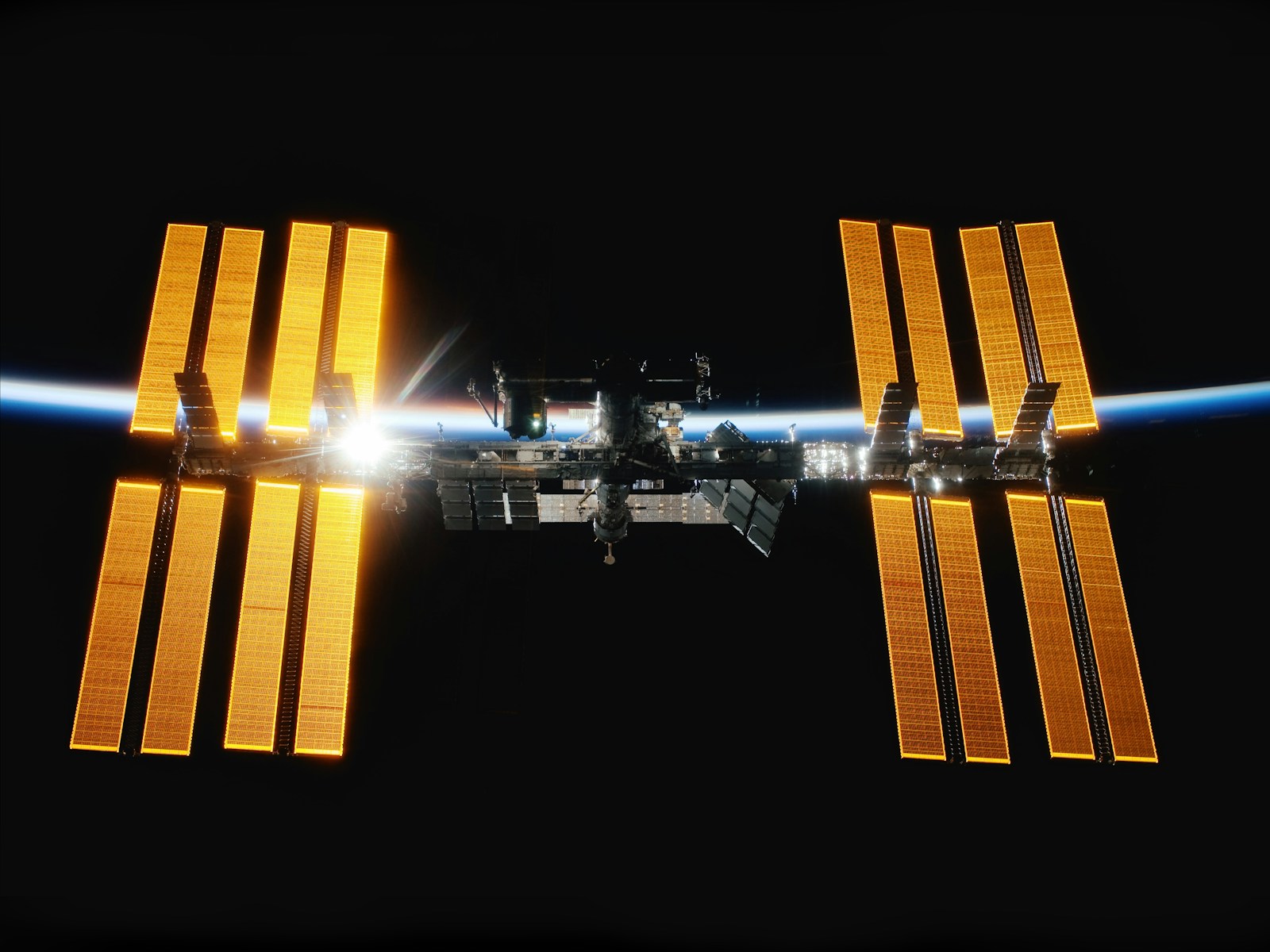

What is the international space station?
The International Space Station (ISS) is a space station that was designed between 1984 and 1993. Parts of the station were constructed throughout the US, Canada, Japan, and Europe, beginning in the late 1980s, with Russia being invited to help in 1993. Assembly of the ISS began in 1998.
Throughout its lifespan, the ISS needed a total of 42 launches and counting in order to assemble it. It constantly requires periodic rocket firings to keep it in orbit, as its low altitude makes it constantly slow down due to atmospheric friction. The number of components attached to the ISS makes it as big as a Boeing 747 airliner in terms of internal volume.
For over 25 years, the station has been constantly occupied. At its maximum, it has occupied 13 people, but it constantly requires an occupancy of 7 nauts at all times. Since the station assembly began, it has required more than 260 spacewalks to assemble it. Alongside it, spacewalks helped maintain it and ensured that it could hold people in the first place. [1]
How does it help humanity?
The ISS’s greatest achievement was being able to allow global cooperation in terms of research. It hosts a micro-gravity laboratory. The benefits the ISS provides are massive.
The ISS relies heavily on robotics to maintain itself. Because it is in zero gravity most of the time, engineers and scientists make sure that every component works together. As a result, the research allowed for great new mechatronic components to be made, and allowed for an advance in robotics.
It has also helped medicine as well. Because of the low gravity in space, astronauts experience bone loss, which is similar to osteoporosis. Because of this, companies on Earth hope to use the low-gravity environment of the ISS laboratory to study osteoporosis medicine and methods to test therapeutics. [2]
Overall, there is so much to study on board the ISS, but there is only so much time that it can handle out in space. It is planned to be decommissioned in 2030, in only four years as of this writing.
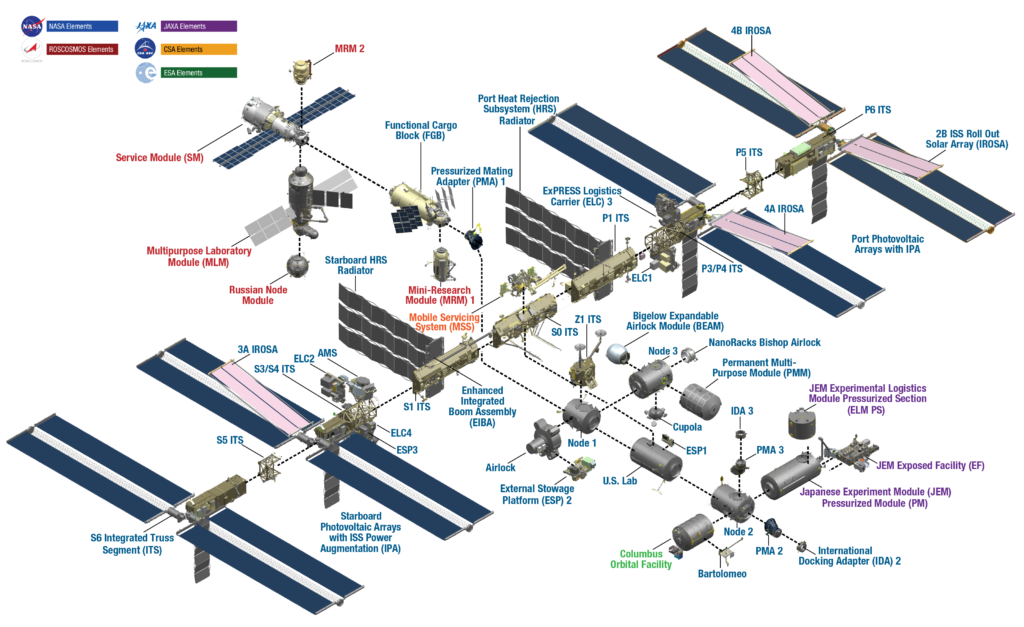
Drawing of the International Space Station with all of the parts labeled. – NASA
Read about satellites here!
Conclusion
In conclusion, the International Space Station stands as one of humanity’s most remarkable engineering and scientific achievements, representing decades of innovation, persistence, and international collaboration.
From its assembly and constant maintenance to its role as a continuously inhabited micro-gravity laboratory, the ISS has advanced knowledge in fields ranging from robotics to medicine. Although its operational lifespan is limited, the legacy of the ISS will continue to influence future space exploration and inspire global cooperation for generations to come.
References
[1] NASA, “International Space Station – NASA,” NASA, May 23, 2023. https://www.nasa.gov/reference/international-space-station/
[2] C. Young, “13 science breakthroughs and experiments, thanks to the ISS,” interestingengineering.com, Dec. 16, 2023. https://interestingengineering.com/lists/13-science-breakthroughs-experiments-iss
No responses yet